

Tesamorelin
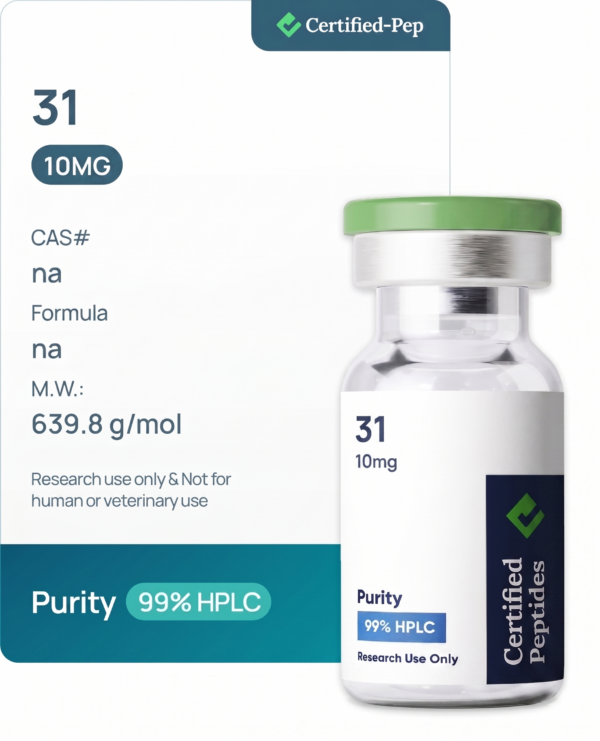
10mg
- Ships same or next day Orders before 3PM EST, FedEx 2-Day Air
- Verify this lot View the lab reports · View the Vanguard certificate
- Real U.S. support Live chat and email, 7 days a week
For research use only. Not for human or veterinary consumption.
Certified-Pep only sells U.S.-made peptides and products.
Key Features:
Made in the USA
Batch tested at a verifiable U.S. laboratory for identity, content and purity
Screened for endotoxins, heavy metals and sterility
Rigorous quality testing on every batch
All products are delivered in lyophilized powder form
For laboratory and research use only
- PURITY: 99%+
- CAS: 901758-09-6
- FORM: LYOPHILIZED POWDER (Acetate Salt)
- DOSAGE: 10 MG
- PURITY: 99%+
| TESAMORELIN 10 MG | |
|---|---|
| SKU | CP_TESAMORELIN_10MG_3ML_VIAL |
| CATEGORY | Lyophilized Peptide |
| CAS | 901758-09-6 |
| VIAL SIZE | 3 mL |
| FORM | LYOPHILIZED POWDER (Acetate Salt) |
| MOLECULAR WEIGHT | 5135.9 g/mol |
| SEQUENCE | 44-aa GHRH analogue with N-terminal trans-3-hexenoyl modification |
| MOLECULAR FORMULA | C221H366N72O67S |
| ITEM ID | 78 |
TESAMORELIN 10 MG provides Tesamorelin as lyophilized powder in a 3 mL vial. The specification table summarizes the named compound and catalog presentation.
Compound Background
Tesamorelin was designed to resist dipeptidyl aminopeptidase-IV (DPP-IV) cleavage, thereby exhibiting slower in vitro degradation in plasma compared with unmodified GHRH(1-44)-NH2. Early nonclinical pharmacology characterized the compound's resistance to DPP-IV deactivation and its prolonged plasma elimination relative to the native peptide [Ferdinandi et al., 2007].
Selected Nonclinical Research
Nonclinical Pharmacology and Toxicology (Rat and Dog Models)
Ferdinandi et al. (2007) evaluated TH9507 in subchronic toxicity studies in rats and dogs. The trans-3-hexenoyl modification slowed in vitro degradation in rat, dog, and human plasma relative to native hGRF(1-44)-NH2. In repeat-dose studies in both species, plasma growth hormone and IGF-1 concentrations increased. Toxicokinetic evaluations indicated dose-related exposure to immunoreactive TH9507. Reversible findings in dogs at sustained supraphysiological GH/IGF-1 exposure included liver and kidney histological changes, anaemia, and clinical chemistry alterations [PMID: 17214611].
Rodent Model – Metabolic Parameters Under Combined Antiretroviral Therapy
Chege et al. (2024) used a Sprague Dawley rat model to investigate interactions between calorie-dense diets and integrase inhibitor-containing antiretroviral regimens. Groups receiving Tesamorelin co-administration were compared with Tesamorelin-free groups on measures including fasting blood glucose, oral glucose tolerance, lipid profiles, hepatic triglycerides, adiposity indices, and growth hormone levels. The Tesamorelin-containing groups showed differences in these metabolic parameters relative to Tesamorelin-free groups maintained on the same diets and antiretroviral regimens [PMID: 38416754].
Rodent Model – Electrocardiographic Parameters
In a related study, Chege et al. (2026) assessed ECG parameters and myocardial histopathology in Sprague Dawley rats receiving combined antiretroviral therapy with calorie-dense diets. Significant intergroup variations in ECG indices (Q, R, S, T wave amplitudes; PR interval; QRS duration; ST height; QTc) were observed. Myocardial fibrosis was noted in Tesamorelin-free groups on calorie-dense diets with antiretroviral regimens, whereas groups receiving Tesamorelin did not exhibit these histological findings [PMID: 42018810].
 Sale
