
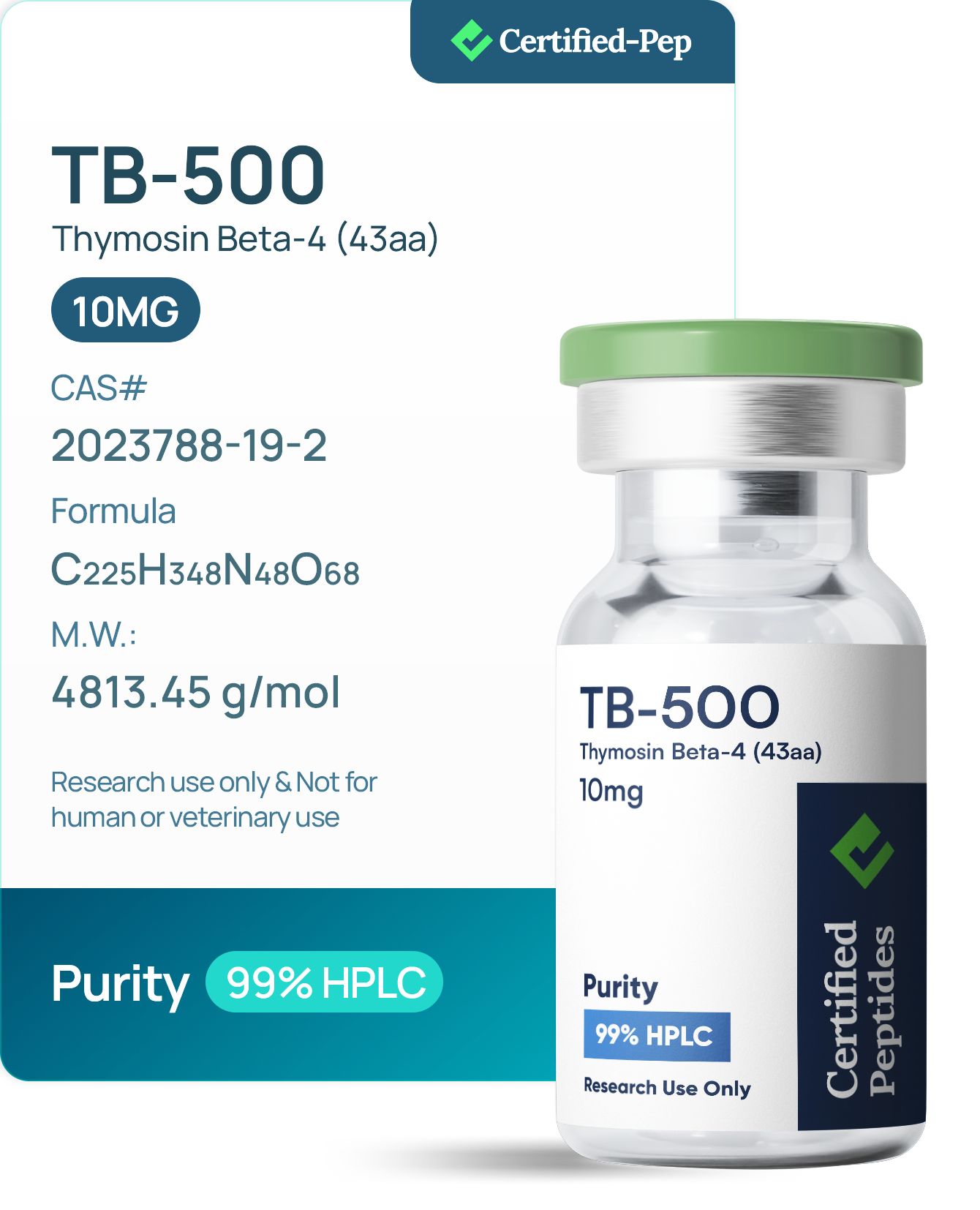
TB-500
10mg
- Ships same or next day Orders before 3PM EST, FedEx 2-Day Air
- Verify this lot View the lab reports · View the Vanguard certificate
- Real U.S. support Live chat and email, 7 days a week
For research use only. Not for human or veterinary consumption.
Certified-Pep only sells U.S.-made peptides and products.
Key Features:
Made in the USA
Batch tested at a verifiable U.S. laboratory for identity, content and purity
Screened for endotoxins, heavy metals and sterility
Rigorous quality testing on every batch
All products are delivered in lyophilized powder form
For laboratory and research use only
- PURITY: 99%+
- CAS: 77591-33-4
- FORM: LYOPHILIZED POWDER (43aa)
- DOSAGE: 10 MG
- PURITY: 99%+
| TB-500 10 MG | |
|---|---|
| SKU | CP_TB_500_10MG_3ML_VIAL |
| CATEGORY | Research Compound |
| CAS | 77591-33-4 |
| VIAL SIZE | 3 mL |
| FORM | LYOPHILIZED POWDER (43aa) |
| MOLECULAR WEIGHT | 4,963.5g/mol |
| SEQUENCE | AC-SER-ASP-LYS-PRO-ASP-MET-ALA-GLU-ILE-GLU-LYS-PHE-ASP-LYS-SER-LYS-LEU-LYS-LYS-THR-GLU-THR-GLN-GLU-LYS-ASN-PRO-LEU-PRO-SER-LYS-GLU-THR-ILE-GLU-GLN-GLU-LYS-GLN-ALA-GLY-GLU-SER-OH |
| MOLECULAR FORMULA | C₂₁₂H₃₅₀N₅₆O₇₈S |
| ITEM ID | 75 |
TB-500 10 MG provides TB-500 vendor designation as lyophilized powder in a 3 mL vial.
Nonclinical Research Findings
Dermal wound repair in rats: In a full-thickness skin-wound model, Tβ4 increased re-epithelialization by 42% at day 4 and up to 61% at day 7 compared with saline controls. Researchers also observed increased collagen deposition and new blood-vessel formation in treated wounds. PubMed
Vascular sprouting in laboratory models: Tβ4 increased capillary-like tube formation in cultured endothelial cells and enhanced vascular sprouting in an isolated coronary artery ring assay. The vessel area approximately doubled through increased branching, supporting its study in angiogenesis and cell–matrix interactions. PubMed
TB-500 and thymosin beta 4: what is in this vial
TB-500 is the trade name research suppliers use for synthetic thymosin beta 4 (Tβ4). The sequence in this vial is the full 43 amino acids of Tβ4, acetylated at the N-terminus, with a molecular weight of 4,963.5 g/mol. Tβ4 itself is a naturally occurring protein found in almost every human and animal cell. Because it is a naturally occurring peptide with a known sequence, this synthetic peptide derived from it is one of the better-characterized research peptides in tissue repair work [1]. Some vendors use “TB-500” for a 7-residue fragment (LKKTETQ) instead. Check the sequence and molecular weight on any TB 500 peptide before comparing data across suppliers.
Cell migration: the primary mechanism
Tβ4 binds monomeric actin, a protein essential for the filaments that let cells crawl. By holding actin in reserve and releasing it where filaments are needed, Tβ4 helps regulate actin and, through it, cell movement [1]. That is the primary mechanism behind most of the research interest. Fibroblasts, endothelial cells and immune cells all have to promote cell migration into damaged tissues before repair can start. Tβ4 also interacts with signaling molecules outside the cell, with downstream effects on inflammatory cytokines and growth factors.
Potential benefits seen in animal models
The potential benefits cited for TB-500 come from studies like these. The kept findings above cover rat skin wounds and blood vessel sprouting. Other animal studies point the same way.
In a mouse model of critical limb ischemia, Lv et al. (2020) found that Tβ4 increased new blood vessels by stimulating angiogenesis and restored blood flow, working through Notch and NF-κB signaling [2]. In a mouse heart attack model, Bock-Marquette et al. (2004) reported that Tβ4 promoted cardiac cell migration and survival, which is why it appears in cardiovascular health research [3]. Corneal wound studies in animals found faster healing along with lower levels of pro-inflammatory cytokines, consistent with potent anti inflammatory properties in that tissue [4]. Those anti inflammatory effects are animal data; whether Tβ4 can reduce inflammation in human inflammatory conditions hasn’t been tested.
Muscle and nerve data are earlier. Tokura et al. (2011) found that Tβ4 released from injured muscle acts as a chemoattractant for myoblasts, the cells behind muscle repair [5]. Muscle recovery in people hasn’t been studied. In rats with traumatic brain injury or stroke, Tβ4 improved functional recovery scores and increased oligodendrocyte markers [6], [7].
These are the studies behind the significant attention TB-500 gets for wound healing, tissue regeneration and regenerative medicine. Studies suggest a role in the healing process, enhancing angiogenesis and reducing inflammation in animal models. They don’t show faster healing, faster recovery or shorter recovery time in people. They also don’t cover muscle injuries, musculoskeletal injuries, joint health, connective tissues, muscle mass, weight loss or gastrointestinal issues in humans.
TB-500 vs BPC 157, the body protection compound
TB-500 is often compared with BPC 157, a 15-residue sequence from body protection compound, a gastric protein. BPC-157 research centers on the gastrointestinal tract, blood vessels and nitric oxide signaling. Tβ4 research centers on actin and cell movement. The two are sold together as the Wolverine stack and appear in larger blends such as GLOW 70MG and KLOW 80MG. Despite the similar name, Thymosin Alpha-1 is a different peptide with a different sequence.
How TB-500 is typically administered in animal studies
In published animal studies, Tβ4 was typically administered by intraperitoneal or subcutaneous injection, or applied topically to wounds [2], [3], [4]. Dose, route and schedule varied from study to study. None of that translates into guidance for people, and this page gives none. Anecdotal reports online mention injection site reactions in people. Those reports are not controlled data.
TB-500 and “advanced recovery strategies”
TB-500 is often marketed as part of advanced recovery strategies for individuals recovering from injury. That framing gets ahead of the data. Progressive rehabilitation, physical therapy and medical assessment are the established, evidence based care for injury recovery. Experimental compounds sold for laboratory research are not part of that care.
Regulatory status: not FDA approved and not a peptide therapy
Its regulatory status is clear: TB-500 is not FDA approved for any human use, and it is not a peptide therapy. Every product sold as TB-500 is a synthetic peptide based on Tβ4, and like other synthetic peptides sold for research, it is a research compound with no approved use. Thymosin beta-4 formulations have reached early human trials in clinical settings for eye and skin wounds [1], but those were not products sold as TB-500. Long-term safety is unknown, including questions about immune reactions and effects on cell growth. Purported benefits, anecdotal reports and certain peptides’ online reputations aren’t evidence. Questions about personal health belong with a qualified medical professional or healthcare professional.
Proper storage and research use
Proper storage keeps the peptide stable. Keep vials sealed, cold and away from light, and follow the storage notes on the batch COA. For laboratory research, log the lot number with each experiment so cellular responses can be traced to a single batch. Ongoing research on Tβ4 changes quickly, so check the date of any paper you rely on.
Quality testing for research peptides
Certified Peptides manufactures in a cGMP facility in Texas. Every batch is tested by an ISO/IEC 17025 accredited US lab for purity (HPLC), quantity, identity (LC-MS), endotoxins, heavy metals and sterility, and batches typically test at 99%+ purity. Researchers who buy TB-500 online from us can match the QR-coded lot on each vial to its report in the COA Library. See Lab Testing for the full panel.
Questions researchers ask
Is this TB-500 the full thymosin beta-4 sequence or a fragment?
This vial contains the full 43-residue thymosin beta-4 sequence with an acetylated N-terminus, at 4,963.5 g/mol (CAS 77591-33-4). Some suppliers use the TB-500 name for a 7-residue fragment, Ac-LKKTETQ, which weighs about 889 g/mol and covers only the actin-binding region. The two aren’t interchangeable in an experiment, so confirm the mass on any COA before comparing data across sources.
How does thymosin beta-4 regulate actin?
Tβ4 binds monomeric G-actin one-to-one and holds it in a form that can’t add to filaments. In many cell types it is the main actin-buffering protein, keeping a reserve of monomers ready to release when the cell needs to build filaments to move or change shape [1]. That buffering role is why cell migration is the main readout in Tβ4 research.
Which model systems have been used to study thymosin beta-4?
The literature spans cultured endothelial cells and keratinocytes, rat full-thickness skin wounds, mouse heart attack and limb ischemia models, corneal injury and rat brain injury and stroke models [2], [3], [4], [6], [7]. Many independent groups have worked on Tβ4, so findings come from more than one lab. Delivery routes and schedules differ widely between studies, which makes direct comparison difficult.
What is Ac-SDKP, and how does it relate to TB-500?
Ac-SDKP is the acetylated N-terminal tetrapeptide of thymosin beta-4. Enzymes cut it from the full-length protein, and the angiotensin-converting enzyme breaks it down, so it has its own research literature as an anti-fibrotic signal [1]. A full-length Tβ4 vial contains that sequence; the 7-residue fragment sold under the same name does not.
Has thymosin beta-4 been tested in humans?
Pharmaceutical-grade Tβ4 has been through early trials, including a US phase 1 intravenous safety study in healthy volunteers [10] and a phase I study of recombinant human Tβ4 in China [11]. Eye-drop formulations have also been tested for dry eye and corneal wounds [1]. None of these led to FDA approval, and none tested products sold as TB-500 by research suppliers.
How should lyophilized TB-500 be stored?
Keep the vial sealed, dry and protected from light, and follow the storage notes on the lot COA. Many labs hold lyophilized peptides at −20 °C for long-term storage. Letting the vial reach room temperature before opening keeps moisture from condensing on the powder.
Disclaimer
For laboratory research use only. Not for human or veterinary use. Not for consumption. This product is not a drug, food or cosmetic. Information on this page is for educational purposes, has not been evaluated by the FDA, and is not intended to diagnose, treat, cure or prevent any disease.
References
- Xing Y, Ye Y, Zuo H, Li Y. “Progress on the Function and Application of Thymosin β4.” Front Endocrinol. 2021;12:767785. doi:10.3389/fendo.2021.767785
- Lv S, Cai H, Xu Y, Dai J, Rong X, Zheng L. “Thymosin-β4 induces angiogenesis in critical limb ischemia mice via regulating Notch/NF-κB pathway.” Int J Mol Med. 2020;46(4):1347-1358. doi:10.3892/ijmm.2020.4701
- Bock-Marquette I et al. “Thymosin beta4 activates integrin-linked kinase and promotes cardiac cell migration, survival and cardiac repair.” Nature. 2004;432(7016):466-472. PubMed
- Sosne G, Qiu P, Kurpakus-Wheater M. “Thymosin beta-4 and the eye: I can see clearly now the pain is gone.” Ann N Y Acad Sci. 2007;1112:114-122. doi:10.1196/annals.1415.004
- Tokura Y et al. “Muscle injury-induced thymosin β4 acts as a chemoattractant for myoblasts.” J Biochem. 2011;149(1):43-48. PubMed
- Xiong Y et al. “Neuroprotective and neurorestorative effects of thymosin β4 treatment following experimental traumatic brain injury.” Ann N Y Acad Sci. 2012;1270:51-58. doi:10.1111/j.1749-6632.2012.06683.x
- Morris DC et al. “A dose-response study of thymosin β4 for the treatment of acute stroke.” J Neurol Sci. 2014;345(1-2):61-67. doi:10.1016/j.jns.2014.07.006
- Malinda KM et al. “Thymosin beta4 accelerates wound healing.” J Invest Dermatol. 1999;113(3):364-368. PubMed 10469335 (rat skin-wound finding above)
- Grant DS et al. “Thymosin beta4 enhances endothelial cell differentiation and angiogenesis.” Angiogenesis. 1999;3(2):125-135. PubMed (vascular sprouting finding above)
- ClinicalTrials.gov. “A Phase 1 Safety Study of the Intravenous Administration of Thymosin Beta 4 in Healthy Volunteers.” NCT00743769. ClinicalTrials.gov
- “A first-in-human, randomized, double-blind, single- and multiple-dose, phase I study of recombinant human thymosin β4 in healthy Chinese volunteers.” 2021. PMC8419156
 Sale
