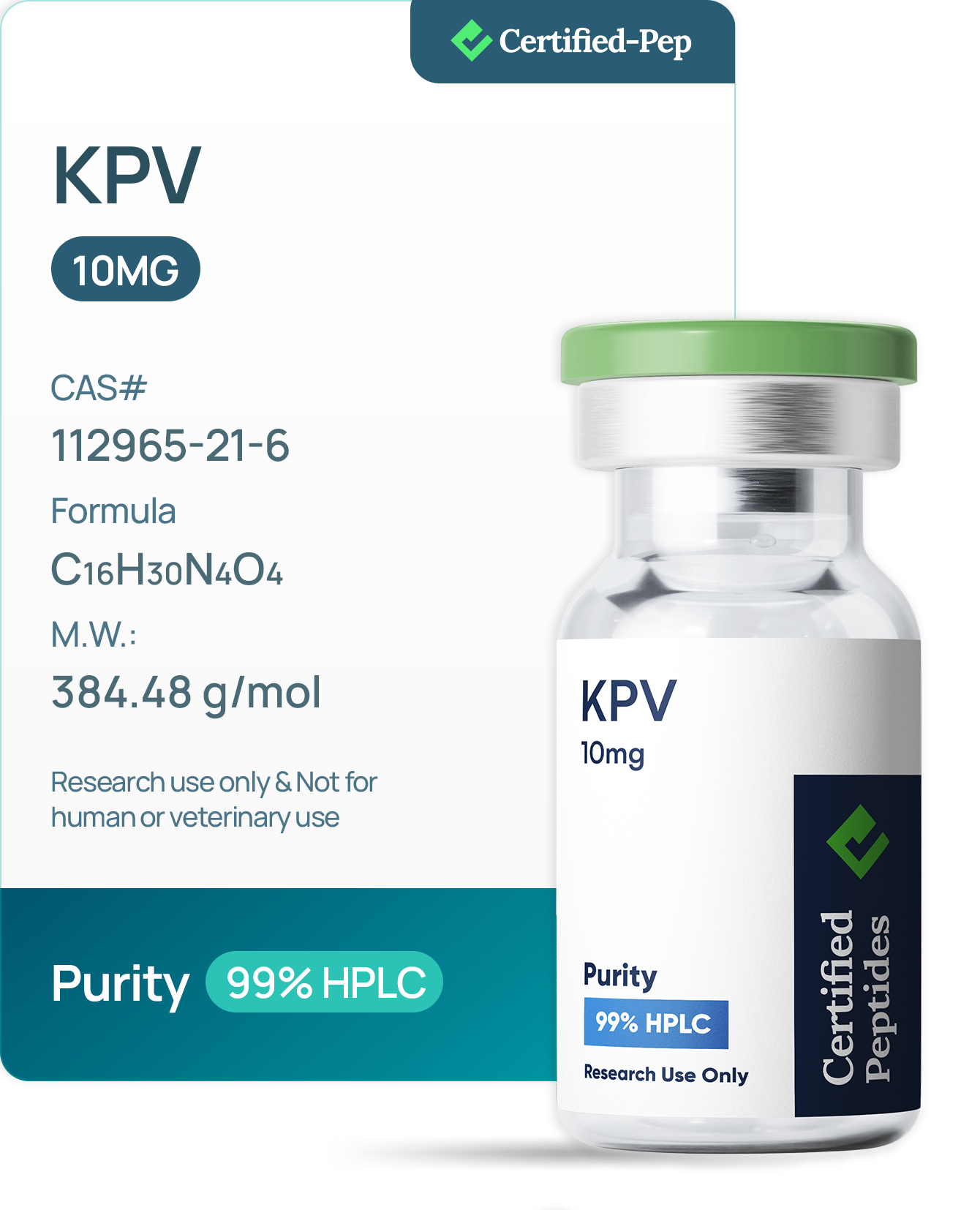
KPV
10mg
- Ships same or next day Orders before 3PM EST, FedEx 2-Day Air
- Verify this lot View the lab reports · View the Vanguard certificate
- Real U.S. support Live chat and email, 7 days a week
For research use only. Not for human or veterinary consumption.
Certified-Pep only sells U.S.-made peptides and products.
Key Features:
Made in the USA
Batch tested at a verifiable U.S. laboratory for identity, content and purity
Screened for endotoxins, heavy metals and sterility
Rigorous quality testing on every batch
All products are delivered in lyophilized powder form
For laboratory and research use only
- PURITY: 99%+
- CAS: 112965-21-6
- FORM: LYOPHILIZED POWDER
- DOSAGE: 10 MG
- PURITY: 99%+
| KPV 10MG | |
|---|---|
| SKU | CP_KPV_10MG_3ML_VIAL |
| CATEGORY | Research Compound |
| CAS | 112965-21-6 |
| VIAL SIZE | 3 mL |
| FORM | LYOPHILIZED POWDER |
| MOLECULAR WEIGHT | 384.48 g/mol |
| SEQUENCE | Ac-Lys-Pro-Val-NH2 |
| MOLECULAR FORMULA | C17H32N6O4 |
| ITEM ID | 11689 |
KPV 10MG provides KPV as lyophilized powder in a 3 mL vial.
Research Context
In Vitro: Keratinocyte Model – Fine Particulate Matter Exposure
In human HaCaT keratinocytes exposed to PM10, KPV was examined for its effects on reactive oxygen species (ROS) production, MAPK/NF-κB signaling, and markers of apoptosis. KPV was associated with attenuation of ROS generation and modulation of signaling intermediates including ERK, p38, and NF-κB. Changes in apoptosis-related protein expression (Bax, Bcl-2, cleaved caspase-3) and IL-1β levels were also reported. Observations were extended to a three-dimensional reconstructed skin model [Sung et al., 2025].
In Vitro: 3T3-L1 Preadipocyte Differentiation Model
In 3T3-L1 preadipocytes induced to differentiate, KPV was evaluated for effects on lipid-staining intensity and adipogenic marker expression. KPV was associated with reduced Oil Red O staining intensity and intracellular triglyceride content in a concentration-dependent manner, along with decreased expression of PPARγ and fatty acid synthase (FAS). Mechanistic analysis indicated involvement of ROS-dependent AKT/mTORC1 signaling [An et al., 2026].
In Vitro: HepG2 Hepatocyte Lipid-Loading Model
In oleic acid-treated HepG2 hepatocytes, KPV was assessed for effects on intracellular lipid accumulation and associated signaling markers. KPV was associated with reduced intracellular lipid accumulation and suppressed FAS expression, with mechanistic data pointing to modulation of ROS generation, ERK activation, and AKT/mTORC1/PPARγ phosphorylation [Lee et al., 2026].
KPV peptide: the anti inflammatory end of α-MSH
KPV is a short peptide of three amino acids, lysine, proline and valine. It is the C-terminal end (residues 11-13) of alpha melanocyte stimulating hormone (α-MSH), sometimes indexed as melanocyte stimulating hormone alpha MSH. The version in this vial is capped at both ends (Ac-Lys-Pro-Val-NH2), which protects the tripeptide from breakdown in lab conditions. Researchers study it because KPV retains much of the anti inflammatory activity of the full hormone [1].
How KPV works on inflammatory signaling
The full α-MSH acts on melanocortin receptors, including the one that drives pigment production. KPV’s anti inflammatory effects appear to work without that route. In mice lacking a functional melanocortin-1 receptor, KPV still reduced colitis [2]. So KPV is described as keeping the anti-inflammatory activity of α-MSH without its hormonal baggage. It also explains why skin darkening hasn’t been reported as a feature of KPV in research models.
Inside cells, KPV enters through PepT1, a transporter for small peptides found in the gut lining [3]. Once inside, it blocks activation of NF-κB, a master switch for pro inflammatory cytokines such as TNF-α and IL-6 [3]. The kept studies above extend this to MAPK signaling and reactive oxygen species.
Gut inflammation, gut health and gut healing in inflammatory bowel disease models
Most KPV data come from colitis models in mice.
Dalmasso et al. (2008) gave oral KPV to mice with chemically induced colitis. Because PepT1 carries KPV into gut cells, oral KPV reduced intestinal inflammation, lowered inflammatory cytokines and cut neutrophil infiltration [3]. Kannengiesser et al. (2008) saw similar effects in two mouse models of inflammatory bowel disease, with less tissue damage in the colon [2]. Xiao et al. (2017) packaged KPV in nanoparticles targeted to the colon. In a mouse model of ulcerative colitis, they reported reduced inflammation and better mucosal healing of the gut lining [4].
These studies are behind the interest in KPV for gut inflammation, gut health, gut healing and the digestive tract. They are animal studies. The potential benefits researchers point to, its potential anti inflammatory properties and reducing inflammation in colitis, come from preclinical research and preclinical studies in animal models. Claims about leaky gut, autoimmune disease or chronic inflammatory conditions in people go beyond published research.
Skin inflammation and human keratinocytes
In human keratinocytes, KPV has been studied for skin inflammation. The kept HaCaT study above found that KPV reduced oxidative stress and inflammatory signaling after particulate exposure. Reviews of α-MSH peptides describe anti inflammatory activity in skin models more broadly [1]. This is cell work on skin health, not data on skin conditions in people.
Immune modulation and immune cells
KPV acts on immune cells and immune responses without broadly shutting down the immune system in the models studied. Cutuli et al. (2000) found that α-MSH peptides, including KPV, had direct antimicrobial effects against Staphylococcus aureus and did not reduce neutrophil killing capacity [5]. That pattern of immune modulation, dampening inflammation while leaving antimicrobial immune function intact, is part of the research interest. Whether KPV affects systemic inflammation or causes immune suppression in humans hasn’t been studied.
KPV vs BPC 157
KPV is often compared with BPC 157. BPC-157 is a 15-amino-acid peptide studied for structural tissue repair and soft tissue repair, with effects tied to blood vessel growth and nitric oxide pathways. KPV works mainly on inflammatory signaling through NF-κB and isn’t studied for structural repair. The two appear together in KLOW 80MG, and KPV is paired with GHK-Cu in K-COPPER 70MG. For oral KPV in a capsule format, see KPV 500 mcg capsules.
Human clinical data and safety
There is no human clinical data for KPV. No human clinical trials have been completed, no data cover autoimmune conditions in people, and there is no human safety data on drug interactions or long-term use. Oral bioavailability has been studied only in mice. Groups rarely used the same protocol, so results are hard to compare across studies. Questions about inflammatory symptoms need medical evaluation by a licensed healthcare professional who knows your health history. A research peptide is not a substitute for medical supervision, and it isn’t a tool to track symptoms or manage overall health.
Is the KPV peptide legal? Is it FDA approved?
KPV is not FDA approved for any human use, and it is not a peptide therapy. Is the KPV peptide legal to buy? For laboratory research, yes: it can be sold and bought as a research peptide. Its status for pharmacy compounding is a separate regulatory question for licensed pharmacies and has no bearing on research supply.
Quality testing
Certified Peptides manufactures in a cGMP facility in Texas. Every batch is tested by an ISO/IEC 17025 accredited US lab for purity (HPLC), quantity, identity (LC-MS), endotoxins, heavy metals and sterility. Product quality matters more for a short synthetic peptide, where a small error in synthesis shifts the molecular weight. When you shop KPV peptide online from us, match the QR-coded lot on each vial to its report in the COA Library, and see Lab Testing for the full panel.
Questions researchers ask
How does KPV get into cells?
KPV is carried into cells by PepT1, a transporter for di- and tripeptides [3]. PepT1 is normally found in the small intestine, but it is also expressed in inflamed colon tissue and in immune cells. That pattern is one reason KPV is studied in models of gut inflammation.
How does KPV block NF-κB signaling?
Once inside the cell, KPV reduced activation of NF-κB and MAPK signaling, the pathways that switch on genes for pro-inflammatory cytokines such as IL-6 and TNF-α [3]. With those pathways dampened, cultured cells and colitis models produced fewer inflammatory signals. The kept keratinocyte study above found similar effects on ERK, p38 and NF-κB.
Does KPV need melanocortin receptors to work?
The parent hormone, α-MSH, acts through melanocortin receptors, and early work suggested KPV might too. In colitis models, though, KPV still reduced inflammation in mice lacking a working melanocortin-1 receptor [2], which points to a receptor-independent route through PepT1. The full picture may differ by cell type, so the receptor question isn’t settled.
Why does this KPV list 384.48 g/mol when other listings show about 342?
The two numbers describe different forms of the peptide. Free KPV (H-Lys-Pro-Val-OH) is about 342 g/mol, while this vial is the capped form, Ac-Lys-Pro-Val-NH2, at about 384 g/mol. The acetyl and amide caps protect the ends of a short peptide from breakdown, so compare data only between the same form.
What models have been used to study KPV?
Mouse colitis models make up most of the data, including chemically induced colitis and T-cell transfer colitis [2], [3], [4]. Cell work covers human keratinocytes, fat cells and liver cells, as in the studies above. There are also antimicrobial assays against Staphylococcus aureus [5].
Should gut researchers choose KPV or BPC-157?
It depends on the question. KPV is a tool for inflammatory signaling through PepT1 and NF-κB, while BPC-157 is studied more for tissue repair and blood vessel growth. Labs studying both mechanisms together can use KLOW 80MG, which contains both.
Disclaimer
For laboratory research use only. Not for human or veterinary use. Not for consumption. This product is not a drug, food or cosmetic. Information on this page is for educational purposes, has not been evaluated by the FDA, and is not intended to diagnose, treat, cure or prevent any disease.
References
- Brzoska T, Luger TA, Maaser C, Abels C, Böhm M. “Alpha-melanocyte-stimulating hormone and related tripeptides: biochemistry, antiinflammatory and protective effects in vitro and in vivo, and future perspectives for the treatment of immune-mediated inflammatory diseases.” Endocr Rev. 2008;29(5):581-602. PubMed
- Kannengiesser K et al. “Melanocortin-derived tripeptide KPV has anti-inflammatory potential in murine models of inflammatory bowel disease.” Inflamm Bowel Dis. 2008;14(3):324-331. PubMed
- Dalmasso G et al. “PepT1-mediated tripeptide KPV uptake reduces intestinal inflammation.” Gastroenterology. 2008;134(1):166-178. PubMed
- Xiao B et al. “Orally Targeted Delivery of Tripeptide KPV via Hyaluronic Acid-Functionalized Nanoparticles Efficiently Alleviates Ulcerative Colitis.” Mol Ther. 2017;25(7):1628-1640. PubMed
- Cutuli M et al. “Antimicrobial effects of alpha-MSH peptides.” J Leukoc Biol. 2000;67(2):233-239. PubMed
- Sung et al. (2025); An et al. (2026); Lee et al. (2026). Keratinocyte, 3T3-L1 and HepG2 studies cited in the research context above.
 Sale