GLOW
70mg
- Ships same or next day Orders before 3PM EST, FedEx 2-Day Air
- Verify this lot View the lab reports · View the Vanguard certificate
- Real U.S. support Live chat and email, 7 days a week
For research use only. Not for human or veterinary consumption.
Certified-Pep only sells U.S.-made peptides and products.
Key Features:
Made in the USA
Batch tested at a verifiable U.S. laboratory for identity, content and purity
Screened for endotoxins, heavy metals and sterility
Rigorous quality testing on every batch
All products are delivered in lyophilized powder form
For laboratory and research use only
- FORM: LYOPHILIZED POWDER
- DOSAGE: 70 MG
| GLOW 70MG | |
|---|---|
| SKU | CP_GLOW_70MG_3ML_VIAL |
| CATEGORY | Research Compound |
| CAS | N/A (Individual Components Below) |
| VIAL SIZE | 3 mL |
| FORM | LYOPHILIZED POWDER |
| MOLECULAR WEIGHT | N/A |
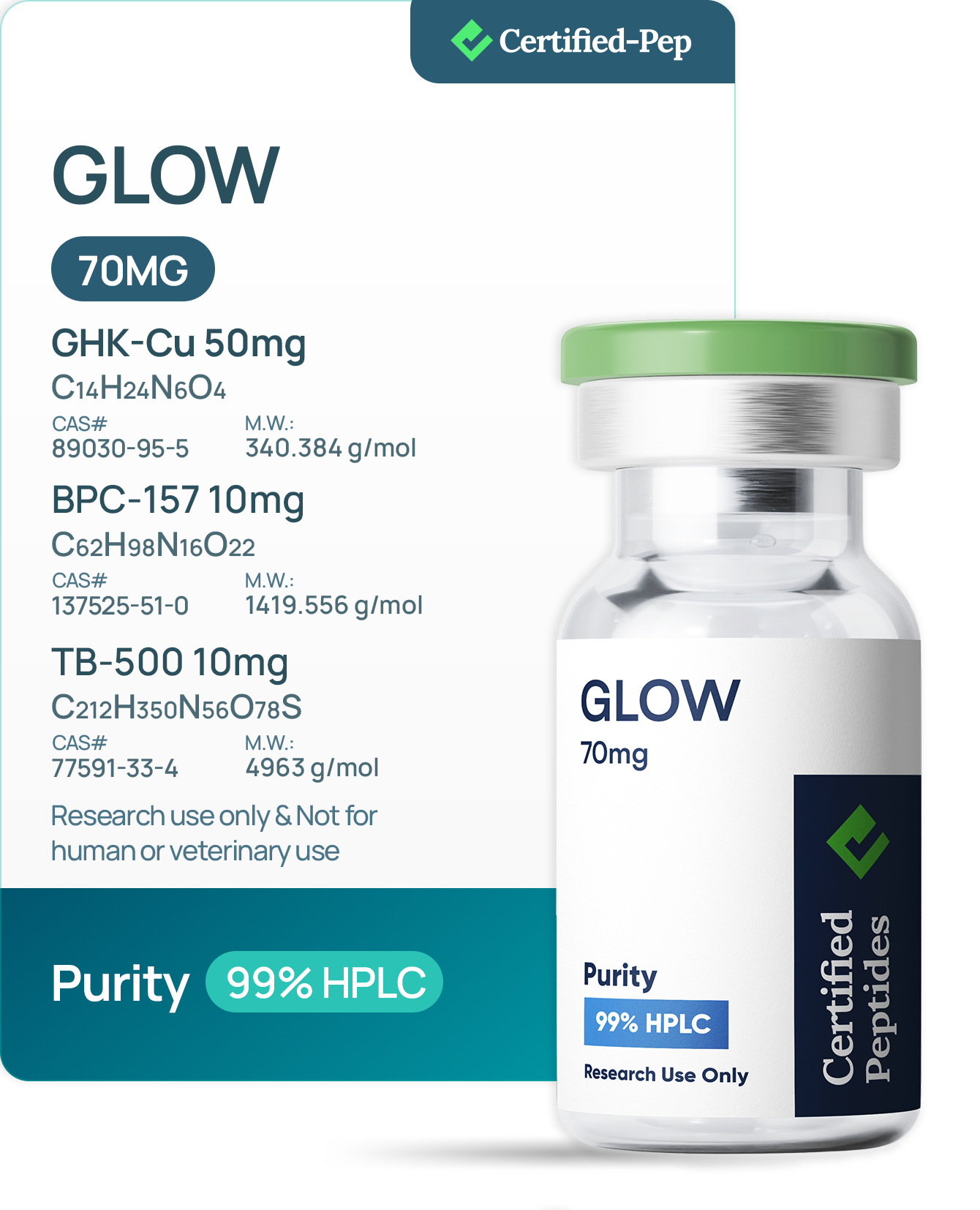
| COMPOSITION | GHK-Cu 50 mg + BPC-157 10 mg + TB-500 10 mg |
| MOLECULAR FORMULA | N/A |
| ITEM ID | 978 |
Individual Component Data:
- GHK-Cu — CAS# 89030-95-5; Formula: C14H24CuN6O4; Mol. Wt.: 403.9 g/mol; Sequence: Gly-His-Lys coordinated to Cu(II)
- BPC-157 — CAS# 137525-51-0; Formula: C62H98N16O22; Mol. Wt.: 1419.53 g/mol; Sequence: Gly-Glu-Pro-Pro-Pro-Gly-Lys-Pro-Ala-Asp-Asp-Ala-Gly-Leu-Val
- TB-500 — CAS# 77591-33-4; Formula: C212H350N56O78S; Mol. Wt.: 4963.44 g/mol; Sequence: SDKPDMAEIEKFDKSKLKKTETQEKNPLPSKETIEQEKQAGES (43 aa; LKKTET actin-binding motif, residues 17-22)
Tendon repair in rats: In a rat model involving surgically transected Achilles tendons, BPC-157 improved the repaired tendons’ resistance to mechanical failure compared with controls. Researchers also observed greater collagen formation and improved organization of repair tissue. [1]
Buy GLOW Peptide Online for Research Use
GLOW 70mg is a three-peptide research blend. When you buy GLOW peptide online from Certified-PEP, a single vial holds GHK-Cu 50 mg, BPC-157 10 mg and TB-500 10 mg, 70 mg in total, supplied together as a lyophilized powder in a 3 mL vial. Labs that study tissue repair models often run these compounds side by side. The GLOW blend puts all three in one vial, so you order, store and track one batch instead of three.
What’s in the GLOW Blend: GHK-Cu, BPC-157, TB-500
Search listings often name it by its parts, GHK-Cu BPC-157 TB-500, but the combination is weighted toward GHK-Cu, which makes up 50 of the 70 mg. Each component keeps its own CAS number: BPC-157 is 137525-51-0, GHK-Cu is 89030-95-5 and TB-500 is 77591-33-4. Because the vial is a mix of three peptides, the blend has no single molecular formula or weight.
GHK-Cu, a Copper Binding Tripeptide
GHK-Cu is a copper binding tripeptide, glycyl-L-histidyl-L-lysine bound to copper(II). The copper binding peptide was first isolated from human plasma and has since been studied in wound, lung and skin health research models. A 2018 review of gene-expression data reported that GHK shifts the activity of a large set of genes tied to tissue remodeling and antioxidant defense [1]. In mice with lipopolysaccharide-induced lung injury, GHK-Cu lowered inflammatory cytokines and markers of oxidative stress [2].
BPC-157, a Synthetic Pentadecapeptide
BPC-157 is a 15-amino-acid synthetic pentadecapeptide based on a sequence from a protein in gastric juice. In a rat model with surgically transected Achilles tendons, BPC-157 improved the repaired tendons’ resistance to mechanical failure, and researchers saw more collagen and better-organized repair tissue than in controls [3]. In cultured rat tendon fibroblasts, it raised growth hormone receptor expression [4]. A separate study in rats and dogs tracked how the peptide is distributed, metabolized and cleared after administration in those species [5].
TB-500 and Thymosin Beta 4
The TB-500 in GLOW carries the CAS number for thymosin beta 4 (Tβ4), a 43-amino-acid peptide that binds actin. Actin controls how cells move and change shape, so Tβ4’s role in research centers on cell migration, new blood vessel growth and inflammatory signaling in cell and animal models [6].
Certificate of Analysis and Third Party Testing
GLOW is manufactured in the USA. Every batch goes to a third party ISO 17025 lab for HPLC analysis of purity and identity, then gets screened for endotoxins, heavy metals and sterility. The HPLC verified results for each lot are posted as a certificate of analysis, and you can view certificate data for the current lot on this page. Match the batch number on your vial label to the one on the report. A reorder may come from a different lot, so check it each time.
Storage and Handling
The lyophilized powder format holds up better in storage than a solution does. Keep vials sealed, protected from light and moisture, and store them cold. Follow the batch documentation for exact temperatures, and log the date and time each vial is opened.
If your work calls for more than one vial, set the quantity before you add GLOW to your cart. The per-vial price drops at higher tiers, so larger orders save on each vial.
Research Use Only
GLOW peptide blend is intended for laboratory research use only. It is not for human consumption, veterinary use or diagnostic use, and it is not labeled for administration to people or animals. It is not a drug, food, cosmetic, dietary supplement or therapeutic product, and these statements have not been evaluated by the FDA.
The studies above tested each compound on its own in cells or animals. None of them tested the three peptides together, and none of these findings describe effects in humans. If you have questions about a batch or its COA, contact our support team before you order.
References
- Pickart L, Margolina A. “Regenerative and Protective Actions of the GHK-Cu Peptide in the Light of the New Gene Data.” Int J Mol Sci. 2018;19(7):1987. doi:10.3390/ijms19071987
- Park J-R, Lee H, Kim S-I, Yang S-R. “The tri-peptide GHK-Cu complex ameliorates lipopolysaccharide-induced acute lung injury in mice.” Oncotarget. 2016;7(36):58405-58417. doi:10.18632/oncotarget.11168
- Staresinic M et al. “Gastric pentadecapeptide BPC 157 accelerates healing of transected rat Achilles tendon and in vitro stimulates tendocytes growth.” J Orthop Res. 2003;21(6):976-983. doi:10.1016/S0736-0266(03)00110-4
- Chang C-H, Tsai W-C, Hsu Y-H, Pang J-H S. “Pentadecapeptide BPC 157 enhances the growth hormone receptor expression in tendon fibroblasts.” Molecules. 2014;19(11):19066-19077. doi:10.3390/molecules191119066
- He L et al. “Pharmacokinetics, distribution, metabolism, and excretion of body-protective compound 157, a potential drug for treating various wounds, in rats and dogs.” Front Pharmacol. 2022;13:1026182. doi:10.3389/fphar.2022.1026182
- Xing Y, Ye Y, Zuo H, Li Y. “Progress on the Function and Application of Thymosin β4.” Front Endocrinol (Lausanne). 2021;12:767785. doi:10.3389/fendo.2021.767785
 Sale