
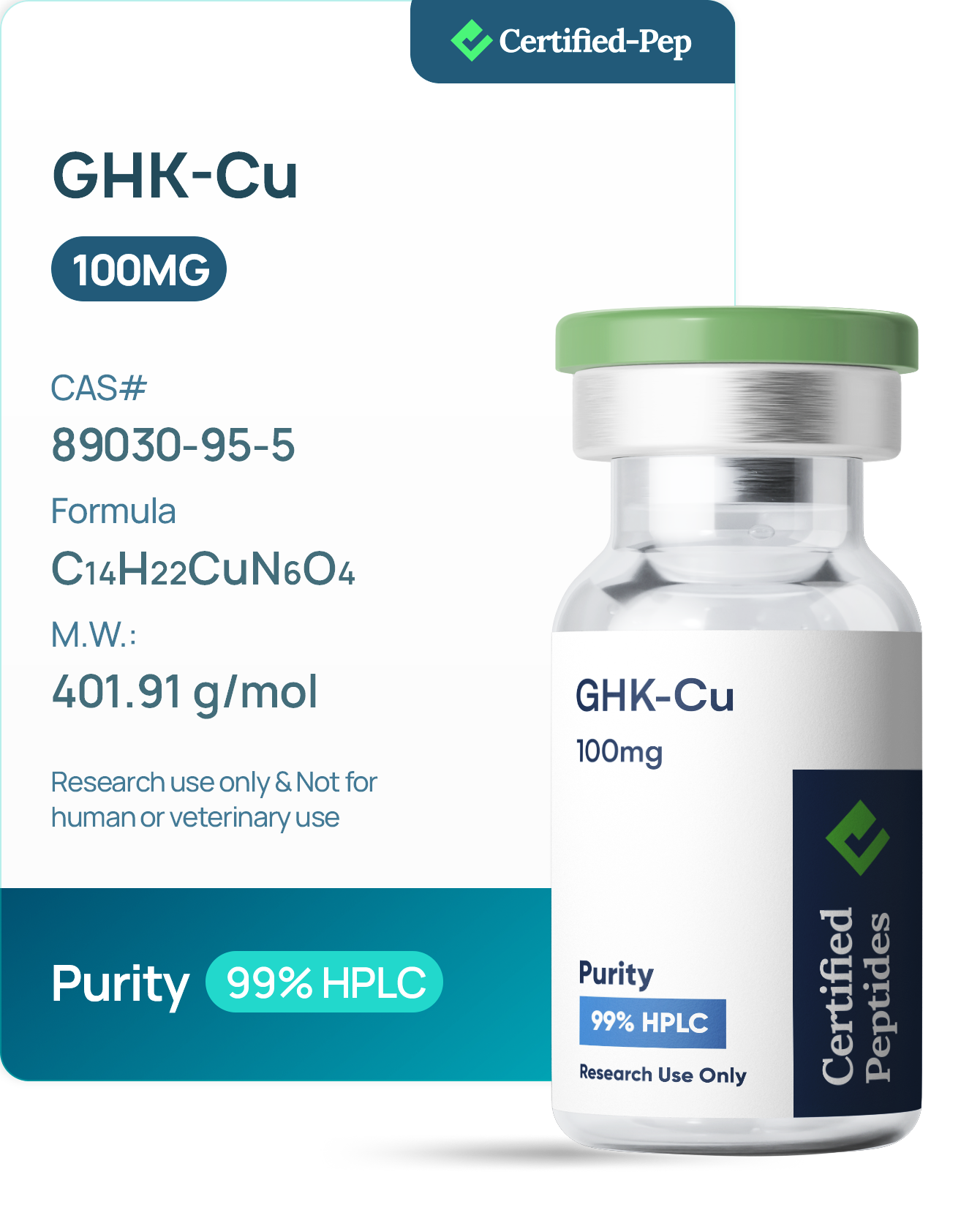
GHK-Cu
100mg
- Ships same or next day Orders before 3PM EST, FedEx 2-Day Air
- Verify this lot View the lab reports · View the Vanguard certificate
- Real U.S. support Live chat and email, 7 days a week
For research use only. Not for human or veterinary consumption.
Certified-Pep only sells U.S.-made peptides and products.
Key Features:
Made in the USA
Batch tested at a verifiable U.S. laboratory for identity, content and purity
Screened for endotoxins, heavy metals and sterility
Rigorous quality testing on every batch
All products are delivered in lyophilized powder form
For laboratory and research use only
- PURITY: 99%+
- CAS: 89030-95-5
- FORM: LYOPHILIZED POWDER
- DOSAGE: 100 MG
- PURITY: 99%+
| GHKCU 100 MG | |
|---|---|
| SKU | CP_GHK_CU_100MG_3ML_VIAL |
| CATEGORY | Research Compound |
| CAS | 89030-95-5 |
| VIAL SIZE | 5 mL |
| FORM | LYOPHILIZED POWDER |
| MOLECULAR WEIGHT | 401.91 g/mol |
| SEQUENCE | Glycyl-L-histidyl-L-lysine (Gly-His-Lys) |
| MOLECULAR FORMULA | C14H22CuN6O4 |
| ITEM ID | 73 |
GHKCU 100 MG provides GHK-Cu as lyophilized powder in a 3 mL vial. The specification table summarizes the named compound and catalog presentation.
Buy GHK Cu peptide online for in vitro laboratory research
GHK-Cu is the copper complex of glycyl-L-histidyl-L-lysine, a three-amino-acid peptide first isolated from human plasma and found elsewhere in the body. It is also searched as GHK Cu, GHK-Cu peptide or copper peptide. When you buy GHK-Cu peptide online from Certified Peptides, you get 100 mg in a lyophilized vial, made for in vitro laboratory research. The powder is blue, a color that comes from the bound copper.
How the copper peptide is built
GHK binds a copper(II) ion through the histidine ring and the peptide’s amine groups. That grip keeps copper in a controlled form, so researchers can study how GHK delivers copper to cells without loose metal driving oxidation. The spec table lists a molecular weight of 401.91 g/mol and a molecular formula of C14H22CuN6O4.
Copper matters here because several enzymes need it. Lysyl oxidase, the enzyme that cross-links collagen and elastin, is one of them. Much of the GHK-Cu literature asks how a peptide that carries copper changes collagen and matrix turnover in cells.
GHK-Cu in wound healing models
Wound healing models are where most of the data sit. In cultured fibroblasts, Maquart et al. (1988) found that GHK-Cu raised collagen synthesis at very low concentrations [2]. In rat wound chambers, Siméon et al. (2000) saw higher levels of glycosaminoglycans and small proteoglycans, the matrix molecules that help organize collagen [3]. In a mouse scald-burn model, GHK-Cu in liposomes sped wound closure, with more cell growth and new blood vessels in the healing tissue [4].
Researchers also use these tissue repair models to look at scars, inflammation and damaged tissue. In mice with lung injury, GHK-Cu led to a reduction in inflammatory signals [6]. In normal human dermal fibroblasts, Gruchlik et al. (2014) measured how GHK and GHK-Cu changed secretion of TGF-β, one of the growth factors that steer repair [7]. Isolated human hair follicles grown in vitro are another model; in one study, GHK-Cu changed follicle growth and dermal papilla cell numbers [8].
GHK, plasma levels and anti aging research
GHK-Cu turns up in anti aging research because plasma concentrations fall with age. In human plasma, GHK sits around 200 ng/mL at age 20 and drops to about 80 ng/mL by age 60 [1]. Gene-expression analyses by Pickart and colleagues report that GHK shifts the activity of many genes tied to tissue remodeling and antioxidant defense [1]. That decline is a documented observation. It is early-phase research and doesn’t show that adding GHK-Cu changes aging or human health.
GHK-Cu, vitamin C and retinoic acid in collagen studies
Vitamin C and copper both feed collagen production. Vitamin C is a cofactor for the enzymes that stabilize collagen, and copper supports lysyl oxidase. Abdulghani et al. (1998) compared topical creams containing GHK-Cu, vitamin C or retinoic acid, and measured collagen in skin biopsies after a month of application [5]. Other cosmetic studies of topical GHK-Cu, summarized in a 2015 review, measured skin density, skin firmness and wrinkle depth [5].
Those were finished skincare and cosmetic formulations applied to skin, so their findings say nothing about this lyophilized powder. Topical GHK-Cu products, wrinkles and skin outcomes are outside what this page supports.
Planning a research protocol
When you write a research protocol for GHK-Cu, note that it dissolves readily in water and that published cell protocols used it at a low concentration. Use the COA as the reference for storage. Lyophilized peptide is usually kept cold, dry and away from light, and protecting the vial from moisture limits breakdown. Record the batch number in your lab notes so every result traces back to one lot. Batch tracking matters more with copper peptides, since copper content affects how the compound behaves in vitro.
Certified Peptides is a research supplier, not a pharmacy or licensed provider. This page gives no guidance on use in people.
GHK-Cu and other peptides in the catalog
GHK-Cu is also part of several blends. GLOW 70MG pairs it with BPC-157 and TB-500, KLOW 80MG adds KPV, and K-COPPER 70MG combines it with KPV alone. For oral research formats, see GHK-Cu 2MG capsules. Other peptides studied in the same matrix and inflammation models include KPV and BPC-157.
Quality testing
Every batch is manufactured in a cGMP facility in Texas and third party tested by an ISO/IEC 17025 accredited US lab. The panel covers purity (HPLC), quantity, identity (LC-MS), endotoxins, heavy metals and sterility, and batches typically test at 99%+ purity. Not all suppliers publish lot-level analysis. Ours sits in the COA Library, and each vial’s QR code links to its batch record. Orders placed before 3 PM ET ship the same or next business day.
Questions researchers ask
Is GHK-Cu the same as GHK? No. GHK is the bare peptide. GHK-Cu is the peptide bound to copper, which is what this vial contains.
Does the evidence cover hair or skin in people? The data on this page come from cells, isolated tissue and animals, plus cosmetic studies of finished creams. Claims that GHK-Cu can promote hair growth or change skin in people aren’t supported by research on this product.
What age-related data exist? Plasma GHK declines with age [1]. That is a measurement, not evidence that the compound alters aging. See Lab Testing and our FAQ for more.
Disclaimer
For laboratory research use only. Not for human or veterinary use. Not for consumption. This product is not a drug, food or cosmetic. Information on this page is for educational purposes, has not been evaluated by the FDA, and is not intended to diagnose, treat, cure or prevent any disease.
References
- Pickart L, Margolina A. “Regenerative and Protective Actions of the GHK-Cu Peptide in the Light of the New Gene Data.” Int J Mol Sci. 2018;19(7):1987. doi:10.3390/ijms19071987
- Maquart FX et al. “Stimulation of collagen synthesis in fibroblast cultures by the tripeptide-copper complex glycyl-L-histidyl-L-lysine-Cu2+.” FEBS Lett. 1988;238(2):343-346.
- Siméon A et al. “Expression of glycosaminoglycans and small proteoglycans in wounds: modulation by the tripeptide-copper complex glycyl-L-histidyl-L-lysine-Cu2+.” J Invest Dermatol. 2000;115(6):962-968.
- Wang X et al. “GHK-Cu-liposomes accelerate scald wound healing in mice by promoting cell proliferation and angiogenesis.” Wound Repair Regen. 2017;25(2):270-278.
- Pickart L, Vasquez-Soltero JM, Margolina A. “GHK Peptide as a Natural Modulator of Multiple Cellular Pathways in Skin Regeneration.” Biomed Res Int. 2015;2015:648108. Includes a summary of Abdulghani AA et al., Disease Management and Clinical Outcomes. 1998;1:136-141.
- Park J-R, Lee H, Kim S-I, Yang S-R. “The tri-peptide GHK-Cu complex ameliorates lipopolysaccharide-induced acute lung injury in mice.” Oncotarget. 2016;7(36):58405-58417. doi:10.18632/oncotarget.11168
- Gruchlik A, Chodurek E, Dzierzewicz Z. “Effect of Gly-His-Lys and its copper complex on TGF-β secretion in normal human dermal fibroblasts.” Acta Pol Pharm. 2014;71(6):954-958.
- Pyo HK et al. “The effect of tripeptide-copper complex on human hair growth in vitro.” Arch Pharm Res. 2007;30(7):834-839.
Tags: ghk cu, ghk cu peptide, laboratory research, hair follicles, wound healing, copper peptide, tissue repair models, bacteriostatic water, peptides
Notes when buying GHK Cu peptide online
GHK-Cu modulates matrix metalloproteinases to remodel tissue.
Topical GHK-Cu is typically used at 1-2% concentration.
Injectable GHK-Cu is administered via subcutaneous injection.
GHK-Cu should be stored at -20°C before use.
Users typically see results in 4 to 12 weeks with GHK-Cu.
Start GHK-Cu application at 2-3 times per week initially.
The delivery method of GHK-Cu affects its safety and efficacy.
GHK-Cu has a strong safety profile in topical research.
Some users experience a transient phase called ‘copper uglies’.
Pregnant or breastfeeding women should consult a doctor before use.
Stop use immediately if rash, hives, or swelling occurs.
Injectable GHK-Cu requires a prescription from a licensed provider.
GHK-Cu can improve skin texture and hydration.
GHK-Cu can increase collagen density by 28% in 12 weeks.
Users report a 55.8% reduction in wrinkle volume after 12 weeks.
GHK-Cu enhances skin hydration and texture within 1 to 2 weeks.
GHK-Cu is studied for its potential in treating hair thinning.
Topical GHK-Cu is ready to use upon purchase.
Injectable GHK-Cu requires reconstitution before use.
Injectable GHK-Cu is reported to deliver faster results.
 Sale
